Tyler Olli
I take ideas from architecture to production, creating products that teams can rely on.
What I Help Teams Do
The outcomes that consistently make a difference.
Ship Without Chaos
Deliver production software without last-minute scrambles, fragile releases, or unclear ownership, so teams can ship with confidence from day one.
Scale Without Rewrites
Design systems that scale with real usage and evolving requirements, without constant re-architecture as the product grows.
Make the Right Tradeoffs
Make clear, defensible tradeoffs under real product, business, and operational constraints to avoid unnecessary complexity and long-term maintenance risk.
Production-Ready AI, Not Demos
Bring AI into production systems with structure, validation, and safeguards that hold up beyond demos, prototypes, and experiments.
Selected Case Studies
High-impact projects that scaled systems, improved workflows, and delivered value.
Account Registration Portal
Designed and delivered a high-volume account registration platform under strict reliability and compliance constraints, coordinating frontend, backend, and platform teams to ship on schedule.
Enabled reliable account creation at scale, improved onboarding conversion, and reduced friction across the registration flow.
Rules-Driven Eligibility System
Designed a flexible eligibility and decision system that governed access to product features, offers, and workflows, allowing teams to update rules without engineering involvement or service downtime.
Lowered the risk, effort, and operational cost of frequent product and policy updates made by content authors.
AI Translation Platform
Built an AI-powered translation workflow that generated localized content for different languages and regions across web applications using structured product and requirements context.
Reduced translation costs and turnaround time while improving consistency across localized content.
ModelTriage
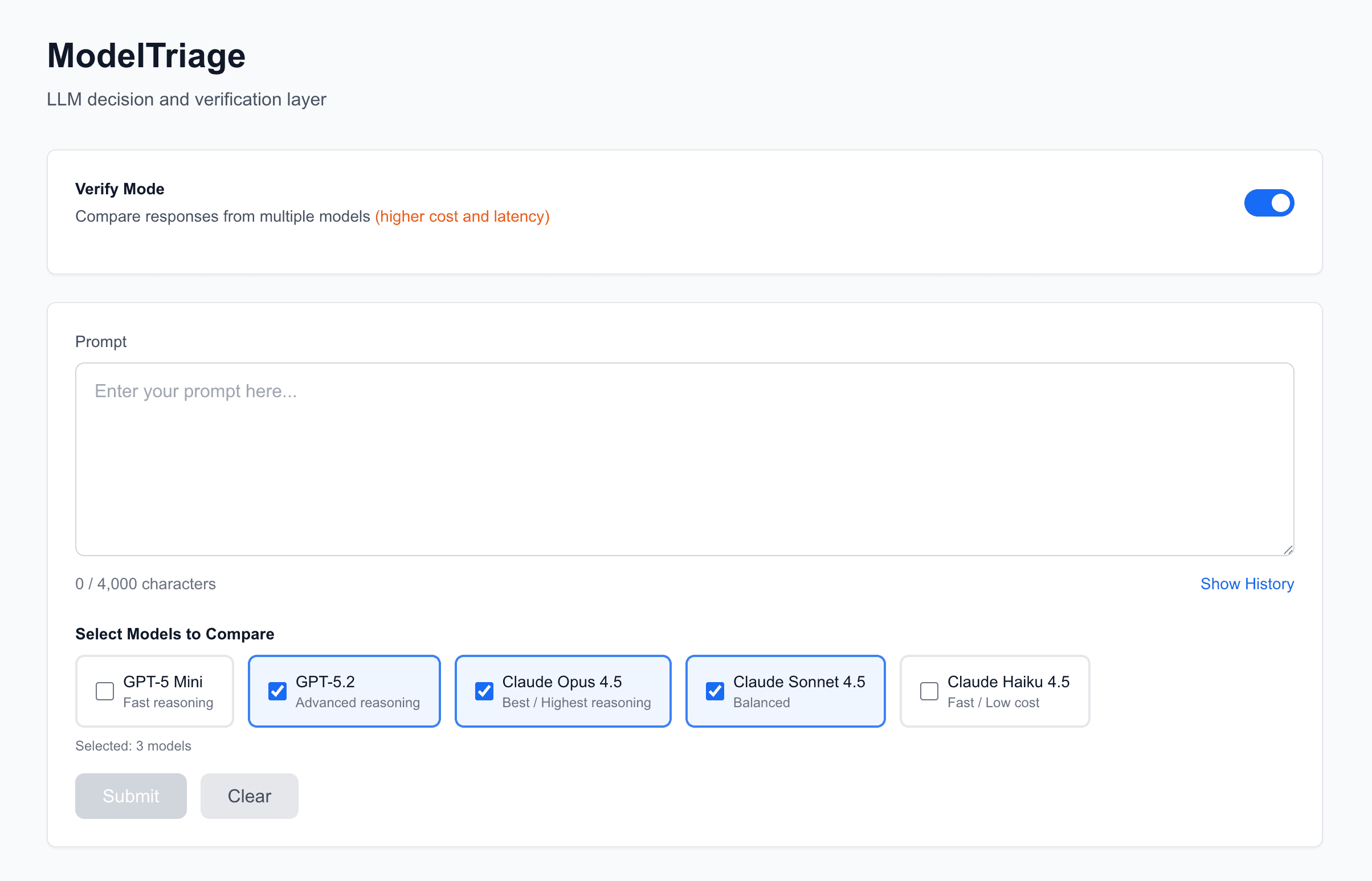
A decision and verification layer that routes prompts to the right LLM and explains model behavior.
How It Works
ModelTriage reads the prompt and any uploaded files to understand the task.
The request is classified and routed to the LLM best suited for that type of work.
When multiple models are queried, responses are analyzed to identify agreement, disagreement, and unique perspectives.
Engineers can review how different models behave on the same task and make an informed decision before production.
Why It Matters
LLM outputs vary widely in quality, cost, and reliability, making model choice a recurring engineering decision rather than a one-time setup.
ModelTriage brings structure to that process through task-aware routing and parallel comparison, giving teams predictable costs, measurable quality, and confidence in model behavior.
Engineering teams use ModelTriage to:
- •Evaluate tradeoffs between models before committing to one
- •Validate prompt behavior across providers, not just a single model
- •Debug inconsistent responses and edge cases early
- •Justify model choices with evidence instead of intuition
Tech Stack
AI in My Engineering Workflow
I use AI-assisted development tools such as Cursor, GitHub Copilot, and Codex to explore ideas and execute faster, while making the final calls on architecture, technical tradeoffs, and what ships to production. This approach shapes how I use AI across my engineering workflow:
Context Engineering
Design structured prompts with clear inputs and expectations, defining success criteria and error handling to produce repeatable, predictable AI workflows.
Code Generation
Draft boilerplate, generate tests, and prototype features faster. AI handles the repetitive work while I focus on architecture and production logic.
Documentation
Generate and maintain API docs, inline documentation, and onboarding guides. Improve cross-team clarity, reduce knowledge silos, and keep system intent documented as code evolves.
Code Review
Identify edge cases, performance risks, and architectural issues. Use AI-assisted review to modernize legacy systems and refactor technical debt with validation at each step.
Agent-Oriented Engineering Systems
I design and operate AI-driven engineering systems where multiple specialized agents execute work in parallel. Agents handle code generation, validation, review, documentation, and migration, while I retain architectural ownership and final decision authority.
I treat context engineering as an agent system design discipline. Agents are designed with explicit inputs, constraints, schemas, and success criteria to improve predictable, repeatable behavior. This turns LLM interactions from ad-hoc prompts into reliable, testable components that integrate cleanly with production systems.
Measurable impact: Reduced feature iteration cycles from days to hours for well-scoped work, enabling 3–5× faster delivery on AI-assisted features and significantly more time spent on system design and high-leverage decisions.
Experience
Lead Software Engineer
Blankfactor • 2023–2025
- Delivered an account registration platform with integrated authentication, unifying onboarding workflows across applications
- Built a centralized eligibility system governing feature access and workflows with support for dynamic rule updates
- Architected systems coordinating services and data pipelines to support personalized experiences across financial products
- Shipped an AI-based localization system that automated multilingual content generation across web platforms
- Pioneered adoption of AI development tools and drove usage across engineering teams by integrating them into production workflows
Senior Software Engineer
Citrix • 2020–2023
- Led end-to-end architecture and delivery for enterprise web platforms supporting NetScaler and XenServer
- Built purchasing systems with reusable workflows, secure SKU lookup, interactive forms, and pricing calculators
- Delivered lightweight, embeddable demo applications used on marketing pages to showcase real usage
- Implimented a company-wide unsubscribe and email preference service backed by MongoDB with centralized opt-out logic
- Built and maintained a centralized component library for React and AEM used across multiple enterprise sites
- Introduced automated testing and accessibility workflows to improve reliability, compliance, and release confidence
Tech Stack
Technologies I use to build and ship production systems.
Core Stack
UI Frameworks
Also: Angular, Vue